

If you look up “buoyancy” on the Internet (we know ‘coz we just did so), you’ll immediately be faced with a barrage of rather intimidating scientific terms and formulas. Indeed, the Google images we saw sorta resembled close-up diagrams of pimples and such; until we realised said diagrams were actually representing round objects (the zit) immersed in fluid (the skin). Boy“ancy” (see what we did there?!), did we view those images wrong.
Nonetheless, these diagrams illustrated the concept of buoyancy perfectly. Namely the weight of an object immersed (or only slightly immersed) in a fluid opposes the force exerted on it by said liquid. “Right”, you may say. “Easy to understand. But what the hell does that have to do with me?” Well, assuming you’re reading this article, you are at least aware of surfing. More specifically, Trident must assume you actually are a core surfer for being on this website in the first place. Unless you’re a hacker, in which case we’d tell you in no uncertain terms to insert your own head in your own bottom.
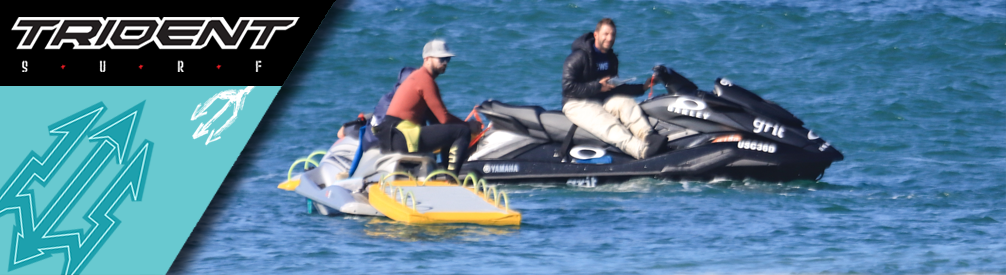
Wavecraft.
Anyways, so we assume you’re a surfer of some kind, even if you ride a lame watercraft such as a paddle ski. Indeed, buoyancy will still apply if you have no watercraft at all. Perhaps you’re one of those weirdo billy-no-mates body surfers. Buoyancy applies here – quite obviously so in fact. So, Trident ain’t gonna quibble over exactly what buoyant objects you prefer to ride on waves (waves, not flat water mind you), but taking the human body as a great example of a buoyant object will illustrate some science today.
The human body, for example; is buoyant in water because of something known as density. Humans are generally more dense than water. Yes, being dense can also apply to that boy who sat next to you in Grade 4 who picked his nose a lot, ate his own hair and couldn’t spell his own name correctly. However in the context of our article today, density refers to mass.
In other words, humans float in water because their overall mass is somewhat less than that of the surrounding liquid. Fun fact, we’ve all seen tons of movies where people fall into volcanoes and become submerged in lava. But no, sadly that won’t happen, as the lava is too dense to sink in. Instead, you’ll burn to death on top of it while screaming in agony.
So ja, there are worse things than merely sinking.
Humans floating in water (we’re not gonna use other fluids at all any more, we made our damn point with the lava!) is partly due to the amount of air in our bodies. Not to mention the water in our bodies being less dense than liquid we find ourselves in. Interesting hey? Indeed, we’d generally have to try quite hard not to float in water. In highly technical terms, this is known in the scientific community as “drowning”. Trident recommends avoiding this phenomenon at all costs.
Anyway, density. Buoyancy. And then: back to stuff we hear about in surfing all the time – volume. What we are driving at in this article is the following; although volume is a handy measurement for buying custom surfboards, we seem to forget the basic function of a surfboard is to float. Yes – just that. And yes, of course we know the heavier you are as a surfer, the more “volume” you need on your board to be able to perform optimally.
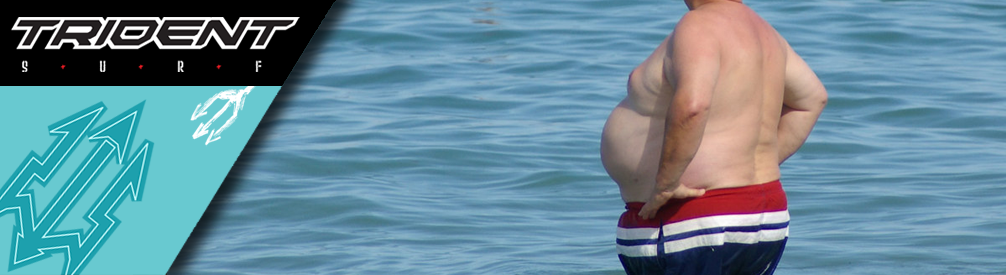
But volume is just that – a measurement, not a real example of how your surfboard will perform. You can be a heavier surfer, with some skill – and your board may be still too buoyant for you. If, for example; you feel like you’re trying to push down the Titanic when you duck dive, your board may be too buoyant.
You need your board to engage with the water, not merely float on top of it when you are surfing. And that’s all we have to say on the subject. For this article at least.
